Free Algebra
Tutorials!
 
 
Home
Solving Nonlinear Equations by Substitution
Solving Absolute Value Inequalities
Quadratic Equations
Real Numbers and Notation
The Distance Formula
Properties and Facts of Addition
Multiplying Complex Numbers
Factoring Trinomials by Grouping
Representing Simple Arithmetic Symbolically
Distributive Rule
Solving Equations by Factoring
Adding and Subtracting Mixed Fractions
Dividing Radicals
Circumference and Area of Circles
Quadratic Equations
Adding and Subtracting Polynomials
Multiplying Multiples of Numbers Together
Linear Equations
Dividing Fractions
Solving Linear Equations
Pagina nueva 1
Adding Triangular Numbers
Rounding Numbers and Estimating Answers
Higher Degree Polynomial Functions
Rules for Arithmetic With Approximate Numbers
Combining Like Radical Terms
Zero Exponent
Proportions
Signs of Products or Quotients of Signed Numbers
Graphing Technology: Parent and Family Graphs
Using the
Solving Nonlinear Equations by Factoring
Graphing Linear Equations
Solving Systems of Equations by Graphing
Slope
Properties of Rational Expressions
Order of Operations
Solving Simple Equations
Powers of Complex Numbers
Factoring By Grouping
Solving Inequalities
Comparing Decimals
Absolute Value Function
Adding and Subtracting Rational Expressions
Multiplying and Dividing Fractions
Product and Quotient of Functions
Multiplication by 12
Negative Exponents and Scientific Notation
Slope
Division Property of Radicals
Special Products
Slope
Negative Exponents
Scientific Notation
The Distance Formula
Solving Systems of Linear Equations in Three Variables
Prime Numbers
Division and Factoring
Solving Equations Involving Rational Expressions
Simplifying Sums and Differences of Square Roots
Solving Linear Systems of Equations by Substitution
Powers of a Monomial
Solving Linear Equations
Solving Equations with Radicals and Exponents
Linear Relations and Functions
Complex Numbers
Simplifying Complex Fractions
Writing Algebraic Expressions
Absolute Value
Factoring General Polynomials
The Slope of a Line
Positive and Negative Slopes
Solving Linear Inequalities with Fractions
Solving Linear Inequalities
Writing Linear Equations in Slope-Intercept Form
Solving Quadratic Equations Using the Quadratic Formula
Solving Equations by Factoring
Factoring Trinomials
Equations Quadratic in Form
Negative Integral Exponents
Solving Equations with Variables on Each Side
Dividing a Polynomial by a Binomial
Synthetic Division
Combining Operations
Linear Equations
Powers
Multiplying Fractions
Dividing Monomials
Multiplication Property of Equality
Percents
Factoring Trinomials by Grouping
Dividing Complex Numbers
Solving Absolute Value Equations
Dividing Rational Expressions
Solving Quadratic Equations
Solving Systems of Equations By Addition (Elimination)
The Product and Quotient Rules
Linear Systems of Equations with No Solution
Solving Quadratic Equations Using the Quadratic Formula
Solving Quadratic Equations by Completing the Square


Slope

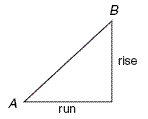
Definition of Slope

Words The slope is the value of the quotient .

Model


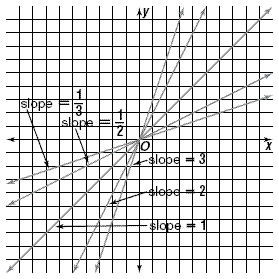
Interpretation of the Slope

Draw three lines whose equations are y = x , y = 2 x , and . These lines look like this in the coordinate plane.
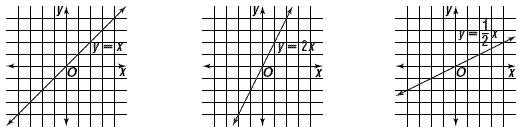
Check the slopes of each of the lines. Note that the line with largest slope of 2 is the steepest, and that the line with least slope of is the least steep.

The figure above shows lines of various slopes.


Slopes of Horizontal and Vertical Lines

"What slope should a horizontal line have?"

Since a horizontal line always has rise equal to zero, the slope will always be zero divided by a positive number, and so the slope is zero. Note that the x-axis has zero slope.

"What about vertical lines?"

Since the run is always zero and division by zero is undefined, the slope is undefined. It is sometimes useful to think of them as having "infinite slope," but since infinity is not a number, this is not a precise statement.


Negative Slope

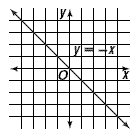
Notice that so far all slopes have been positive numbers, and all lines have sloped upward from left to right. For lines drawn in the coordinate plane, the standard direction to move along them is from left to right and bottom to top.
Key Idea

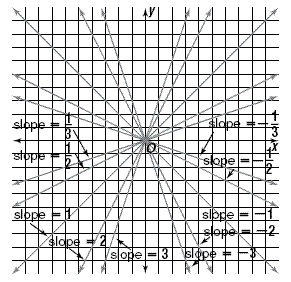
Lines with positive slope rise to the right and lines with negative slope rise to the left.

  • For positive slopes, the larger the number, the more steeply the line slopes upward.
  • For negative slopes, the larger the absolute value of the negative number, the more steeply the line slopes downward.

The next figure shows lines of both positive and negative slopes.
 

Algebraic Formula for Slope

Let's summarize the whole discussion by introducing the algebraic formula for slope. To do this, we draw two points in the coordinate plane that correspond to the ordered pairs (x 0 , y 0) and (x 1 , y 1), as in the figure below.
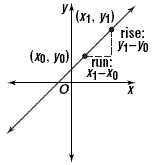
The rise is y 1 - y 0 and the run is x 1 - x 0 . Slope is rise divided by run, which gives the formula
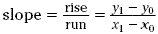
Values can be substituted into this formula once the coordinates are given. It does not matter which points are designated as (x 0 , y 0) and (x 1 , y 1). However, the first x in the denominator must come from the same coordinate pair as the first y in the numerator.

 
All Right Reserved. Copyright 2005-2007